Skip to content
JoulepointJoulepoint
  • Live demo
  • Developers
Request a Briefing
DC fast-charging controller & PLC · ready-to-assembleEngineered in India

Flashed. Burned. Boxed. Two brains. One supplier. Zero integration glue.

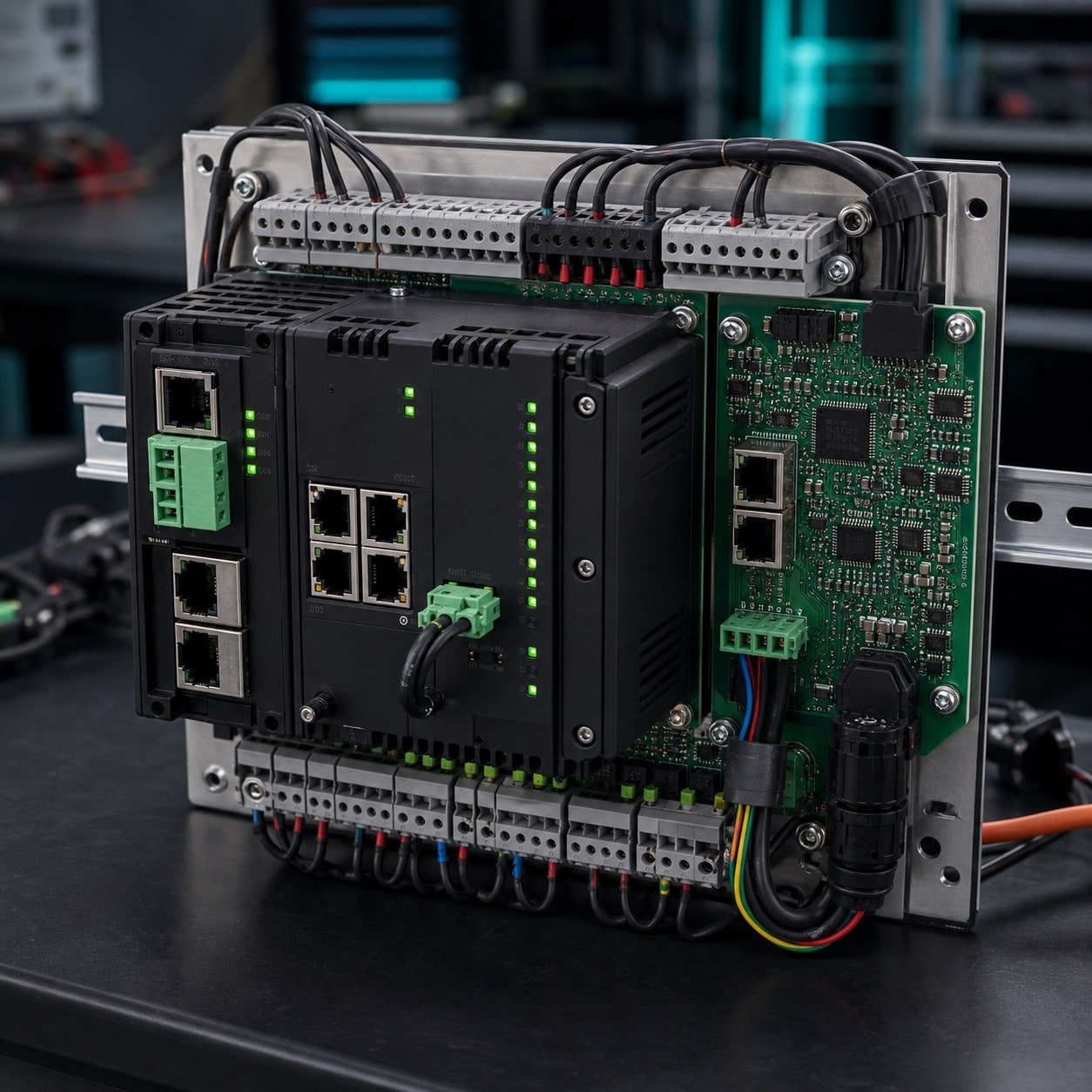
JP-PLC — a WiFi-enabled Dual-core PLC (factory-flashed) and JP-CTRL — a Quad-core Industrial Controller (image pre-loaded). The EV-side brain and the Linux-side brain of a DC fast charger. Certified firmware inside. Built-in UV/OV + ground-fault protection. WS2812B-driven RGB LED animations. RS485 + CAN + Ethernet + WiFi + USB + HDMI on-board. Snap together, wire up, ship.

See the architectureOrder the kit
JP-CTRL
Quad-core Linux
JP-PLC
WiFi Dual-core
Charging
OCPP 2.0.1
PnC
ISO 15118-2/-20
Safety
JP-SAFE
Status
WS2812B
JoulePoint JP-CTRL controller and JP-PLC module

Joulepoint

DC fast-charging controller & PLC · ready-to-assemble

JP
JP
Controller pillars

Six things the controller does that most chargers can't.

Most charger problems aren't about the power electronics — they're about the brain. This is what we rebuilt.

Production-grade controller

Linux-based controller running our hardened charging stack. Real-time control plane to the power modules, supervisory plane to the CSMS, operator plane to the kiosk HMI.

Tailscale Remote Tunnel

Optional encrypted peer-to-peer mesh tunnel for support and diagnostics. No port forwarding, no static IPs, no cellular VPN bills. Toggle on only when needed.

Hot-reloadable config

Edit modules, OCPP profile, RFID, planner, PLC transport, authorization — and save without restarting the controller. Field-tunable in minutes.

White-label HMI

Upload your logo and support phone. The kiosk and admin views rebrand immediately. OEM-ready on day one.

Per-device licence

Activation codes are minted against the Linux device fingerprint. Codes for any other unit are rejected — refurb and clone protection without DRM friction.

Multi-vendor modules

Driver-based abstraction over power modules (LAN GenericKM2 BLN and others). Qualify two or three module vendors and source whichever wins each batch.

Tested with · the EVs on Indian roads

Every EV sold in India, handshake-validated against the JoulePoint stack.

From the Tata Ace EV on your last-mile fleet to the Kia EV9 at the family parking bay — the SLAC engine, HLC stack, Plug & Charge handshake, and module CAN orchestration are validated against 16+ brands and 44 passenger and commercial models. New India-launch lineups join the test matrix as they land.

Filter by category
Tata MotorsTATA

Nexon EV · Punch EV · Tiago EV +3

MahindraMAHINDRA

XUV400 · BE 6 · XEV 9e

Maruti SuzukiMARUTISUZUKI

e Vitara

MG MotorMG

ZS EV · Comet EV · Windsor EV +1

HyundaiHYUNDAI

Kona Electric · Ioniq 5 · Creta Electric

KiaKIA

EV6 · EV9 · Carens Clavis EV

BYDBYD

Atto 3 · Seal · e6 +1

CitroënCITROËN

eC3 · eC3 Aircross

ŠkodaŠKODA

Enyaq

VinFastVinFast

VF 6 · VF 7 · VF e34

Tata Ace EVTATA ACEEV

Ace EV · Yodha EV · Intra V20 EV

Fleet
EicherEICHER

Pro 2049 EV · Pro 6055 EV

Fleet
Switch MobilitySWITCHMOBILITY

EiV 12 · IeV4 LCV

Fleet
OlectraOLECTRA

K9 · C9 · K7

Fleet
JBM AutoJBM

Galaxy · Citylife

Fleet
PMI ElectroPMIELECTRO

Featherlite · PMI-FE

Fleet

Connector compatibility

Every connector your customers will roll up with.

CCS2Type 2 ACGB/TCHAdeMO

CCS2

Primary India standard

Used by every passenger EV brand on this page — the JoulePoint default validation target.

Type 2 AC

AC backup path

Type 2 AC compatible for vehicles that fall back from CCS2 DC during pre-charge or thermal events.

GB/T

China-fleet ready

Driver path validated via the Tonhe module family for sites with imported Chinese commercial EVs.

CHAdeMO

Legacy support

Driver path available for older fleet vehicles still on CHAdeMO — same controller, no hardware change.

16+

Brands on the test matrix

Indian + global, mass + premium

44

Models validated

passenger + commercial

6

Countries of origin

India · Korea · Germany · China · Japan · USA · Sweden · France · Czechia · Vietnam · UK · Italy

4

DC connector types

CCS2 (primary) · Type 2 AC · GB/T · CHAdeMO

Brand names, model names, and marks shown are the property of their respective owners. The “tested with” claim refers to vehicle-side handshake validation (SLAC, HLC, ISO 15118-2/-20, OCPP-side metering and stop conditions) against vehicles of these brands — no endorsement, partnership, or affiliation is implied. Validation coverage is continuously extended as new EVs reach India.

Architecture · the split-brain platform

Two brains. One supplier. Zero integration glue.

Every Joulepoint charger is built from two cooperating compute units plus a hardware safety chain. The PLC owns everything the EV touches; the controller owns everything the operator and the CSMS touch. Regulatory-slow firmware stays still — product-fast software ships monthly.

Joulepoint Charger · live signal flow
Control Power Safety

EV

CCS2 · CCS1 · GB/T

CP / PE · HPGP
CP / PE · HPGP

EV-side brain

JP-PLC

WiFi Dual-core · HPGP modem · 3-relay drive · WS2812B

  • SLAC · HLC · PnC
  • CP/PWM + EV identity
  • Relay + safe-stop
  • Connector LED ring
USB-CDC
USB-CDC

Linux-side brain

JP-CTRL

Quad-core ≥ 1.5 GHz · ≥ 2 GB RAM · RS485 · CAN · ETH · WiFi · USB · HDMI

  • OCPP 1.6J + 2.0.1
  • Planner + module CAN
  • Meter + journal
  • HMI + cabinet LED

Power modules

Maxwell · UUGreen · Tonhe

CAN
CAN

DC output

to EV battery

OCPP · WSS
OCPP · WSS

Your CSMS

OCPP 1.6J · 2.0.1

JP-CTRL peripherals

JP-HMI

7 / 10 / 15" HDMI capacitive touch

JP-RFID

USB HID · ISO 14443 · MIFARE

Status visibility

WS2812B addressable RGB on both the connector collar and the cabinet — themable per OEM.

Backhaul

Ethernet · WiFi · LTE · Tailscale auto-failover.

JP-SAFE · hardware-rooted safety chain

UV · OV · phase-loss · ground-fault · IMD · welded-contactor · surge · ESD · tamper · thermal — independent of both MCUs. If the firmware locks up, JP-SAFE still trips.

MCU-independent
PLC

JP-PLC

WiFi-enabled Dual-core PLC

Power-Line Communication

Sealed module, factory-flashed, NVS-provisioned to your charger ID + gun ID

Owns

  • CP / PWM (IEC 61851-1)
  • SLAC matching (ISO 15118-3)
  • HLC stack — DIN 70121 + ISO 15118-2
  • Plug & Charge (V2G PKI)
  • EV identity capture (EVCCID/EMAID)
  • Relay drive + safe-stop logic
  • Connector-collar RGB LED engine
CTRL

JP-CTRL

Quad-core Industrial Controller

Linux supervisory + ops plane

Sealed industrial unit, image pre-loaded, ≥ 1.5 GHz, ≥ 2 GB RAM, signed boot

Owns

  • OCPP 1.6J + 2.0.1 (CSMS link)
  • Authorization, RFID, MAC autocharge
  • Smart-charging power planner
  • Module CAN control plane
  • Crash-safe journal + meter driver
  • Web HMI + OEM theme pack
  • Cabinet RGB LED engine
SAFE

JP-SAFE

Hardware safety chain

Hardware-rooted, MCU-independent

Analog + digital safety board between AC input and the DC stage — trips even if both MCUs lock up

Owns

  • UV / OV / phase-loss
  • Ground-fault (6 mA AC + 6 mA DC)
  • IMD (insulation monitoring)
  • Pre-PreCharge isolation test gating
  • Welded-contactor detection
  • Hardware E-Stop chain
  • Surge + ESD + tamper + thermal

Why split the brain?

Regulatory cycles for high-voltage HLC firmware (ISO 15118) are slow. Linux controller cycles (OCPP profiles, UI, billing, planner) are fast. JoulePoint lets your product team ship monthly UI and OCPP updates without retouching certified HLC firmware. One image scales from STD to XTREME — no code forks per SKU.

Ready-to-assemble components · the JP family

Seven sealed components. One cable kit. One CSMS URL.

Every SKU below ships flashed, tested, and provisioned to your charger ID. You don't compile anything. You don't NDA-license anyone's SDK. You bolt them in, wire the harness, scan the QR code, and the charger is live.

Brain · Linux

JP-CTRL

Industrial-Grade Controller

Quad-core Linux brain. Image pre-loaded. RS485 · CAN · Ethernet · WiFi · USB · HDMI · WS2812B — all on-board.

  • STD · PRO · XTREME tiers
  • Signed boot + OTA + rollback
  • OCPP 1.6J + 2.0.1 inside
  • Pluggable terminal blocks, DIN-rail or panel mount
Brain · EV-side

JP-PLC

WiFi Dual-core PLC

Sealed module, factory-flashed with the full SLAC + HLC + PnC stack. HomePlug GreenPHY modem on-board.

  • 1G · 2G · NG variants (factory-paired)
  • 3-relay drive + connector LED out
  • USB-CDC to controller — single cable
  • SW4 captive setup portal
Hardware safety

JP-SAFE

Safety Chain Board

UV · OV · phase-loss · ground-fault · IMD · welded-contactor · surge · ESD · tamper · thermal — hardware, not firmware.

  • 6 mA AC + 6 mA DC RCD-MD
  • IEC 62752 / IEC 61851 Annex E
  • Hardware E-Stop chain
  • MCU-independent — trips even if firmware locks
Display

JP-HMI

Capacitive Touchscreen

7″ · 10″ · 15″. 10-point capacitive, optical bonded, sunlight-readable option.

  • Single HDMI + single USB
  • Auto-detected by JP-CTRL
  • AG coating standard, 400 / 1000 nits
  • Metal / IP65 outdoor bezel option
Identity

JP-RFID

USB HID RFID/NFC Reader

ISO 14443-A/B, MIFARE Classic / DESFire, HID Prox, EM4100, NTAG2xx — plug-and-play.

  • Decimal → uppercase LE hex auto-normalized
  • Linux EVIOCGRAB exclusive grab
  • Online OCPP + offline allowlist
  • Tap-to-stop on active session
Status

JP-LED

WS2812B RGB Kit

Connector-collar ring + cabinet status strip. Driven independently by PLC and Controller.

  • OEM palette + custom keyframe packs
  • Idle, SLAC, HLC, charging, fault, OTA
  • Auto-dim via ambient-light input
  • < 1% CPU at 30 fps
Install kit

JP-WIRING

Color-Coded Harness

Pre-built, factory-cut, color-coded harness with pluggable Phoenix-style terminals. Match colors, done.

  • 2G · 4G · NG variants
  • Pluggable terminal blocks throughout
  • No soldering on install
  • Factory-cut lengths for the reference cabinet
Time to first CCS handshakeHoursnot 9–18 months
Source code to integrateZerofirmware ships sealed
Support contracts to manageOnePLC + CTRL + SAFE + LED
JP-CTRL · three tiers · one image

Same image. Same OTA channel. Three industrial-grade hardware tiers.

The controller image runs unchanged across STD, PRO, and XTREME — only the silicon changes. No code forks per SKU, no per-tier firmware build, no extra QA matrix. Pick the chassis your deployment climate and topology demand.

JP-CTRL-STD

Standard

Entry / mid · 1–2 gun

Operating temperature

0 to +60 °C

  • Quad-core ≥ 1.5 GHz, 2 GB RAM
  • RS485 · CAN · 1× ETH · WiFi · 2× USB · HDMI · WS2812B-out
  • 32 GB eMMC, signed boot
  • Entry tier for 1–2 gun cabinets
Most popular
JP-CTRL-PRO

Pro

Production · 2–4 gun · networked

Operating temperature

−20 to +70 °C

  • Quad-core ≥ 1.8 GHz, 4 GB RAM
  • Dual ETH · WiFi 6 · BLE · 4× USB · CAN-FD · audio out
  • M.2 LTE / 5G slot for cellular backhaul
  • Networked sites, 2–4 gun cabinets
JP-CTRL-XTREME

Xtreme

Industrial / outdoor / extreme climate

Operating temperature

−40 to +85 °C

  • Quad-core ≥ 2.0 GHz, 8 GB RAM, 128 GB eMMC
  • Dual CAN-FD · dual RS485 · PoE-in · 24 V industrial I/O
  • TPM 2.0 hardware root of trust
  • Conformal-coated for outdoor / marine / dusty

Full hardware matrix

Spec-by-spec across all three tiers

CapabilitySTDPROXTREME

Compute

CPUQuad-core ≥ 1.5 GHzQuad-core ≥ 1.8 GHzQuad-core ≥ 2.0 GHz
RAM2 GB DDR44 GB DDR48 GB DDR4
Storage32 GB eMMC64 GB eMMC128 GB eMMC

I/O

RS4851×1×2× isolated
CAN1× iso1× CAN-FD iso2× CAN-FD iso
Gigabit Ethernet1×2×2×
WiFi2.4 / 5 GHzWiFi 6WiFi 6
USB2×4×4×
HDMI 1080pIncludedIncludedIncluded
WS2812B outIncludedIncludedIncluded
BLE—IncludedIncluded
M.2 LTE / 5G slot—IncludedIncluded
Audio out—IncludedIncluded
PoE-in——Included
Isolated 24 V industrial I/O——Included
TPM 2.0——Included

Environmental

Operating temp0 → +60 °C−20 → +70 °C−40 → +85 °C
Conformal coating——Included
What ships on every Joulepoint charger

14 admin capabilities. All built in.

Every Joulepoint charger ships with a production-grade admin and kiosk HMI — no separate UI subscription, no third-party vendor portal. Below is what your operators get out of the box.

Operator overview

Single-pane controller / CSMS / PLC / network health, plus a live operations snapshot — the first thing your field engineer sees on every visit.

Per-connector workspace

Live electrical values for every gun, session and auth state, planner context, vehicle demand — plus stop / clear-fault controls without leaving the kiosk.

Session analytics

Active and historical sessions with energy, power, duration, and per-row deep links. Built in, not a separate dashboard product.

Site-aware power planner

Hot-reloadable site limit, OCPP SmartCharging integration, group power cap per PLC chain, cross-PLC borrowing toggle — editable without a controller restart.

Fault Center

Connector and PLC fault history with active vs resolved separation. No more digging through 30 MB log files to find what tripped the bay.

Live Configuration Editor

Edit modules, OCPP, RFID, planner, PLC transport, authorization — and save without restarting the controller. Field-tunable in minutes.

White-label HMI

Upload your logo and support phone. The kiosk and admin views rebrand immediately. OEMs ship branded UI on day one.

Network workspace

Wi-Fi SSID scan + on-screen connect, wired primary device control, gateway and address visibility, plus a one-click Capture Diagnostic for field handoff.

Remote Support Tunnel (Tailscale)

Optional encrypted peer-to-peer mesh tunnel. The charger works fully without it — leave it off when you don't need remote access. No port forwarding, no static IP, no cellular VPN bill.

PLC ops

Per-chain health for every PLC chain in the cabinet — separate from controller health so you can isolate where a fault really lives.

Logs

Time-windowed runtime log access from the UI. Pair with Capture Diagnostic to ship an evidence bundle to engineering without SSH.

Maintenance workspace

Health checklist plus operator-grade actions: Refresh Health, Recompute Planner, Restart Controller. No full reboot, no field engineer escalation.

Per-device licence

Activation codes are minted against the Linux device fingerprint of that specific controller. Codes for any other unit are rejected — anti-counterfeit and refurb protection without DRM friction.

Multi-vendor module support

Driver-based abstraction over power modules. Qualify two or three vendors and source whichever wins each batch — no firmware change.

Live walkthroughs and screen recordings are available under NDA — talk to our sales engineering team.

The end-to-end charging flow

From plug-in to PowerDeliveryStop — every state, journaled, replayable.

What actually happens between T+0 and T+END on a Joulepoint charger. Every CP transition, SLAC step, HLC sub-state, AUTH check, relay command, module ramp, and meter read is timestamped and exported to the controller's journal.

CP detectSLAC matchHLC handshakeAuthorizationIsolation + PreChargeCurrentDemandStop & disarm
  1. T+0CP detectEV

    EV gun inserted

    Driver plugs in. CP transitions A → B1 within milliseconds.

  2. T+0.1sCP detectJP-PLC

    CP debounce + plug-detect

    JP-PLC samples the CP front-end, debounces, and emits a connector state event to the controller. Connector LED ring switches from idle breathe to plug-detect.

    [SERCTRL] EVT CP state=B1
    WS2812B ring → solid OEM color
  3. T+0.2sAuthorizationJP-CTRL

    Session created · heartbeat lease

    JP-CTRL opens a new session, leases a heartbeat to the PLC, and queues authorization while SLAC is armed.

    CTRL HB
    CTRL AUTH pending
    CTRL SLAC start (single shot — PLC owns retry)
  4. T+0.5sSLAC matchJP-PLC

    SLAC matching (ISO 15118-3)

    PLC starts PWM @ 5 % duty and runs the full SLAC handshake: CM_SLAC_PARM → MNBC → ATTEN_CHAR → SLAC_MATCH.

    WS2812B ring → SLAC sweep animation
    [SERCTRL] EVT SLAC state=Matched
  5. T+3sHLC handshakeJP-PLC

    HLC handshake (DIN 70121 + ISO 15118-2)

    TCP + TLS over EXI. SupportedAppProtocol → SessionSetup. EVCCID / EMAID captured.

    [SERCTRL] IDENTITY evccid=…
    ISO sub-state tagged at every message
  6. T+3.5sAuthorizationJP-CTRL

    Authorize

    Identity is checked in this order: OCPP Authorize.req → local allowlist → RFID allowlist → MAC autocharge (if enabled).

    CTRL AUTH grant
  7. T+4sHLC handshakeJP-PLC

    ChargeParameterDiscovery → CableCheck

    PLC continues the HLC sequence and exports every ISO message sub-state + age to the controller.

    [SERCTRL] EVT HLC substate=CableCheck
  8. T+5sIsolation + PreChargeJP-SAFE

    Isolation monitor pass

    JP-SAFE confirms isolation > threshold. Only after this does the PreCharge sequence advance.

    EVT HLC substate=CableCheck iso=valid
  9. T+8sIsolation + PreChargeJP-CTRL

    PreCharge complete · close all relays

    EV voltage is within ΔV of EVSE. Controller commands all three relays closed with a hold timeout.

    CTRL RELAY enable=0x07 state=0x07 hold=2500ms
    Module CAN ramp @ 200 V/s, 60 A/s, with deadband
  10. T+9sCurrentDemandJP-PLC

    CurrentDemand · charging starts

    PLC enters CurrentDemand and answers the EV with controller-fed values. Connector LED switches to the charging power-bar animation; cabinet LED pulses online.

    CTRL FEEDBACK valid=1 present_v=400 present_i=125
    OCPP StartTransaction (EVCCID as idTag if autocharge)
  11. SteadyCurrentDemandJP-CTRL

    Steady-state — every 100 ms

    BMS publishes target V / target I / SOC / stage every 100 ms. Module CAN @ 100 ms control / 50 ms telemetry. Orchestrator clamps to module capability + site limit. Meter @ 1 s for OCPP MeterValues. JP-SAFE monitors UV / OV / ground-fault continuously.

    Joulepoint Module Orchestrator: minimum active modules to meet demand
    Dual-register Wh anti-fraud check
    HMI SSE @ 2 s — battery animation + kW + kWh + SOC + ETA
  12. T+ENDStop & disarmJP-CTRL

    Soft stop · ramp down · disarm

    EV / user / RFID / CSMS triggers STOP. Modules ramp down (300 V/s, 120 A/s) → wait for quiet current → open relays. JP-SAFE confirms no welded contactor. OCPP StopTransaction with final meterStop.

    Welded-contactor detection → alarm if needed
    WS2812B ring: stop fade → idle breathe
    Charger back to Idle, ready for next plug-in

Every step above is replayed by Joulepoint field-support from the on-board journal. The exact ISO message, relay command, or module ramp that misbehaved is quoted back to you in minutes — not hours.

JP-SAFE · hardware-rooted protection

Safety is not a firmware feature. It is the wiring.

JP-SAFE sits between the AC input and the DC stage as an independent analog + digital board. If both MCUs lock up, JP-SAFE still trips. Every protection here is hardware-rooted — and every trip event is journaled, surfaced to the HMI, raised to the CSMS via OCPP, and flashed on the cabinet LED strip.

AC input

Grid · 1Φ / 3Φ

JP-SAFE

Hardware safety chain · MCU-independent

UV / OVPhase lossGround-faultIMDSPD / ESDInrush limitWelded-contactorTamper / thermal

DC stage

Contactor · modules · gun

Independent E-Stop chain

The mushroom button cuts contactor drive directly — bypassing both MCUs. The controller is informed, not consulted.

Bypasses firmware

Under-voltage (UV)

Per-supply tunable

Configurable threshold with hysteresis to avoid chatter. Trips contactor below set point.

Over-voltage (OV)

Per-supply tunable

Configurable threshold above the rated supply. Hard trip protects every downstream stage.

Phase loss / sequence

3-phase aware

Detected on 3-phase input. Trips contactor and reports to controller for CSMS alarm.

Ground-fault (RCD-MD)

6 mA AC · 6 mA DC

Residual-current monitoring per IEC 62752 / IEC 61851-1 Annex E. Separate AC and DC thresholds.

Insulation Monitor (IMD)

Pre-PreCharge gating

Industry-standard Bender / SMA-compatible analog interface. Trip on insulation below threshold.

Welded-contactor detection

Post-stop verification

Runs after every PowerDeliveryStop. Welded? Charger is automatically removed from CSMS service.

Hardware E-Stop chain

MCU-independent

Mushroom button interrupts contactor drive independently of firmware. Controller is informed but not in the safety path.

Surge protection (SPD)

Class-II

Class-II SPD on AC input. GDT + MOV stack catches grid transients before the DC stage.

ESD protection

All external ports

TVS diodes on every external signal line. Per-rail current monitor logs abnormal draw.

Thermal cutout

Ramp + cutoff

NTC on the cabinet temperature. Power ramps down at the soft threshold, hard trip at the limit.

Tamper switch

Cabinet door

Cabinet-open input. Logs the event, optionally disables service until cleared by operator.

Reverse-polarity + inrush

Boot-time safe

Protected controller DC input. NTC + bypass relay inrush limiter on supply rails.

On any trip

Journaled

Append-only event in the controller journal

On any trip

Surfaced

HMI fault card with class + timestamp

On any trip

Raised

OCPP alarm + diagnostic upload

On any trip

Encoded

WS2812B red flash with morse fault class

WS2812B · addressable RGB

Every state, told by the cabinet — before you read a screen.

Addressable RGB lives in two places: the connector collar ring (driven by JP-PLC) and the cabinet status strip (driven by JP-CTRL). Drivers cross a station and know what's happening from a hundred metres away. OEM palette is themable, animation choreography is a JSON keyframe pack — no firmware rebuild.

Default

Cabinet strip

Idle / available

Slow breathe in the OEM accent color. Cabinet strip pulses gently.

Cabinet strip

Plug detected (CP B1)

Solid brand color the instant CP transitions A → B1.

Cabinet strip

SLAC matching

Sweep / chase animation. Cabinet pulses faster to mirror handshake progress.

Cabinet strip

HLC handshake

Faster sweep until the EV answers with ChargeParameterDiscovery + CableCheck.

Cabinet strip

Authorization pending

Yellow pulse — RFID or CSMS Authorize.req in flight.

Most visible state

Cabinet strip

Charging

Power-bar fill. Hue shifts from cyan → green as SOC climbs. Cabinet glows online.

Cabinet strip

Fault

Red flash with morse-coded fault class. Cabinet flashes in sync.

Cabinet strip

OTA in progress

Blue progress bar on the connector ring, chase on the cabinet strip.

Pixels addressable

16+24

per gun (typical)

CPU overhead

< 1 %

at 30 fps

Themable per OEM

JSON

no firmware rebuild

Problems we solve · competitive advantage

Why CPOs and EVSE OEMs win with Joulepoint chargers.

Most charger problems aren't about the power electronics — they're about the controller, the HMI, the remote access, the licensing, and the lock-in. We rebuilt that whole layer.

Truck-roll for every config change

Industry default — every parameter tweak means a field visit

Hot-reloadable Config Editor + Remote Tunnel: change driver, modules, OCPP profile, RFID, planner from anywhere, no controller restart.

Expensive cellular VPN for remote diagnostics

Most CPOs pay $30–80 per charger per month for a managed APN + remote SSH

Built-in Tailscale mesh — peer-to-peer, encrypted, no port forwarding, no static IP. Toggle on only when support is needed.

Power-module vendor lock-in

Most charger controllers are hard-wired to one module brand

Driver-based module abstraction (we ship LAN GenericKM2 BLN and others). Source the cheapest qualified module without rewriting firmware.

No anti-piracy on the controller

Refurbed and grey-market chargers eat OEM margin

Per-device hardware-bound licence — activation codes are minted from a Linux device fingerprint; codes for any other unit are rejected.

Custom HMI takes 6–12 months to build

Most OEMs ship a vendor HMI on top of someone else's controller

Production-grade admin HMI with white-label logo + support phone upload. OEMs ship a branded UI on day one.

Multi-connector power sharing is a mess

Static splits waste headroom; live sharing usually needs a separate dispatcher box

Built-in site-aware planner: site limit + OCPP SmartCharging + group cap + cross-PLC borrowing — hot-editable from the UI.

Field staff can't recover faults without the OEM

Operators end up calling the OEM for every fault, every time

Fault Center, Refresh Health, Recompute Planner, Restart Controller — operator-grade actions in the UI, no SSH required.

CSMS lock-in by the controller vendor

Many OEM controllers only talk to that OEM's CSMS

Native OCPP 1.6J / 2.0.1 — point Charge-Point ID + CSMS URL at any CSMS (ours, AmpEco, Driivz, Monta, your own). Change it from the live config without firmware.

What this actually saves you

Concrete cost arguments by buyer persona. Numbers are mid-market estimates from public CPO operating benchmarks and our own deployments in India and Europe.

For Charge-Point Operators

CPO
  • Cut remote-access spend

    Tailscale's free / starter plans replace the typical cellular APN + VPN concentrator. For a 500-charger network this is $15k–$40k/year of OPEX gone, with stronger encryption than most managed APNs.

    ~$30–80 / charger / month saved

  • Kill truck-rolls for config

    Every site visit costs ₹3,000–8,000 in fuel + engineer time in India, $100–400 in the EU/US. Hot-reload + remote tunnel removes 60–80% of those visits — the ones that exist today only to change a parameter or restart a process.

    ~60–80% of config-driven truck-rolls eliminated

  • Stop paying for a third-party HMI

    Our kiosk + admin is included. No separate UI subscription, no per-charger licence on top of the controller, no $5–15/month-per-charger HMI vendor.

    $60–180 / charger / year saved

For EVSE Manufacturers / OEMs

OEM
  • Ship a branded controller on day one

    Upload your logo + support phone, mint per-device licence codes from a fingerprint. Skip the 6–12 month effort of building your own admin HMI and licensing pipeline.

    ~6–12 months engineering avoided

  • Protect aftermarket revenue

    Each activation code is bound to a specific Linux device fingerprint. Refurbished units can't be cloned, grey-market boxes can't bypass spare-parts revenue.

    Refurb / grey-market arbitrage removed

  • Source modules competitively

    The module abstraction lets you qualify two or three power-module vendors and quote whichever wins each batch — without firmware changes. Direct margin lift on every cabinet.

    5–15% margin on power-module BOM

Remote Support Tunnel · Tailscale

The cheapest, safest, most operator-controlled remote access in the industry.

Most CPOs pay $30–80 per charger per month for a managed cellular APN plus a VPN concentrator just so engineering can SSH in. We replaced that with Tailscale's peer-to-peer encrypted mesh — the same technology used by enterprise infra teams. It costs almost nothing, encrypts end-to-end, requires no port forwarding, and the operator can revoke a key in a single click.

Plan a remote-access pilotSee what's built in
  1. 01

    Optional by default

    Charger ships with the tunnel OFF. The unit works fully without it.

  2. 02

    Operator opt-in

    When you need remote support, the operator turns the tunnel on from /admin/tunnel.

  3. 03

    Auth key issued by your tenant

    The shared key is minted by your support tenant — not by a third-party VPN vendor — so revocation is in your hands.

  4. 04

    Peer-to-peer mesh

    Tailscale connects engineer ↔ charger over its encrypted mesh. No port forwarding on the site router, no static IP, no SIM-card APN.

  5. 05

    Operator-grade controls

    Disconnect, Logout (keep key), or Forget Key — three states the operator controls, all from the UI.

  1. 01

    Device fingerprint

    On first boot the controller derives a Linux device fingerprint. The Licence page shows it so you can copy it to your vendor support contact.

  2. 02

    15-character activation code

    Support mints a 15-character code bound to that exact fingerprint. Codes for any other unit are rejected at activation.

  3. 03

    Verified state

    Once active, every page shows a verified badge with activation date, stored code, and code file path.

  4. 04

    Refurb / clone protection

    Refurbished or grey-market units can't reuse another unit's code. Protects OEM aftermarket revenue without imposing DRM friction on the legitimate operator.

Per-device hardware-bound licence

Anti-counterfeit, refurb-aware — without DRM friction.

Each activation code is derived from the Linux device fingerprint of that specific controller. Refurbished units can't be cloned, grey-market boxes can't bypass spare-parts revenue, and the legitimate operator never has to deal with a network-call licence check.

  • Device fingerprint shown on /admin/license — copy it to your vendor support.
  • 15-character activation code, bound to that fingerprint.
  • Activation works offline; no phone-home required after first activation.
  • Stored code path visible (/opt/evse/data/license.code) for forensic audit.
Site planner + PLC chains

One planner. Many connectors. No external dispatcher box.

The controller runs a site-aware planner that respects the contracted grid cap, OCPP SmartCharging profiles, group power caps per PLC chain, and cross-PLC borrowing — all live, all hot-editable.

Site limit (kW)

Hot-reloadable transformer/grid cap. Changes apply within ~50 ms.

OCPP SmartCharging limit

Respects active SmartChargingProfile from the CSMS.

Group power per PLC chain

Per-chain cap so a sticky vehicle doesn't starve siblings.

Cross-PLC borrowing

Optional — let an idle chain lend headroom to a busy one.

Live planner analytics

Requested / offered / allowed / assigned kW visible per cycle.

HomePlug Green PHY PLC

ISO 15118 PLC the way it's supposed to work.

The PLC stack is observable, swappable, and tunable from the admin — not a black box. Each chain reports health separately so you can isolate a failed chain without guessing.

ParameterValue
StandardHomePlug Green PHY · ISO 15118 PLC profile
Frequency range2–30 MHz
Data rateUp to 10 Mbps typical
Per-cabinet chainsMultiple PLC chains supported, cross-PLC borrowing under planner control
InterfaceEthernet / CAN to the controller, PLC physical to the vehicle inlet
Power supply9–16 V DC
Operating temperature−40 °C to 85 °C
ProtectionSurge + ESD protected, conformal coated
Health visibilityEach PLC chain surfaces healthy / faulty separately to the admin Fault Center
OCPP + ISO 15118 conformance

Every message the CSMS asks for — answered, signed, and observable.

CapabilityProfileJoulepoint
StartTransaction / StopTransactionOCPP 1.6J ✓
Authorize / IdTagOCPP 1.6J + 2.0.1 ✓
MeterValues + signed OCMFOCPP 1.6J + 2.0.1 ✓
RemoteStart / RemoteStopOCPP 1.6J + 2.0.1 ✓
SmartCharging (Profile)OCPP 1.6J + 2.0.1 ✓ planner-aware
FirmwareUpdate (signed)OCPP 1.6J + 2.0.1 ✓ signed + rollback
Diagnostics uploadOCPP 1.6J + 2.0.1 ✓ Capture Diagnostic bundle
Security Profile 3 (TLS + cert)OCPP 2.0.1 ✓ TPM-backed
ISO 15118 PnC handshakeISO 15118-20 ✓ PKI provisioning
OCPI Locations / CDRsOCPI 2.2.1 ✓ via CSMS
Production-validated · the numbers

The proof is in the journal — not in a marketing deck.

What "production" means here: 6 of 6 controller tests passing, 53 module orchestration unit tests across 3,419 lines all green, OCPP boot + connect verified against the production CSMS, live MAC autocharge across the full sequence, a 6× field overbill caught before the customer complained.

↓ from 14.7 % pre-optimization

2.8%

Idle CPU (entry tier)

Quad-core ≥ 1.5 GHz baseline · controller image, idle session

Before vs after

Before
14.7
After
2.8
↓ from ~77 % previously

12–18%

Charging-state CPU

Including full module CAN + planner + journal + HMI

Before vs after

Before
77
After
15

< 25s

Cold boot to ready

Power-on to first session-accepting state

Before vs after

Before
100
After
25

< 2s

Crash recovery

Journal-replayed; resumes a live transaction

Before vs after

Before
100
After
4

< 4W

Idle power (entry tier)

Wide-input 9–36 V DC, reverse-polarity protected

Up to 16

Concurrent connectors

Per controller (PRO / XTREME tier)

6× overbill

Anti-fraud catch in field

52 kWh reported vs 8.5 kWh delivered — caught by dual-register Wh consistency check

53 · 3 419 LoC

Module orchestration unit tests

All passing — every release

Standards & certification posture

Inside every kit, validated every release.

16+ standards
StandardScopeJoulePoint status
ISO 15118-3SLAC · HPGP physical layerInside JP-PLC — validated on real EVs
DIN 70121DC HLCInside JP-PLC — production traffic
ISO 15118-2AC + DCInside JP-PLC
ISO 15118-2 PnCPlug & Charge contract certsInside JP-PLC — cert chain + OCSP
ISO 15118-20DC BPT (V2G)Roadmap — same hardware, OTA upgrade path
IEC 61851-1Control PilotInside JP-PLC
IEC 61851-21-2EVSE EMCReference designs aligned · JP-SAFE front end
IEC 61851-23DC chargerReference designs aligned
IEC 61851 Annex ERCD-MDInside JP-SAFE
IEC 62752RCD-MD (IC-CPD)Inside JP-SAFE
ISO 17409EV-side isolationJP-SAFE IMD interface
OCPP 1.6JCharge Point ProtocolInside JP-CTRL — CSMS-validated
OCPP 2.0.1Charge Point ProtocolInside JP-CTRL
GB/T 27930China DCModule CAN supported via Tonhe driver
WiFi (CE / FCC / IC)WirelessJP-CTRL + JP-PLC pre-tested
Common Criteria · TPM 2.0Hardware root of trustJP-CTRL-XTREME
JoulePoint vs the field

The same problem. A fundamentally better delivery model.

A side-by-side against every category of competitor we encounter — the bare-HLC vendors, the DIN-rail HLC vendors, the carrier-board ecosystems, the NDA-SDK vendors, the build-it-yourself path, and the closed turnkey OEMs.

vs

Phoenix Contact · CCS family

Bare HLC module — you integrate everything else.

Them JoulePoint
CapabilityPhoenix ContactJoulePoint
Form
Bare HLC module to integrate
Flashed PLC + pre-loaded controller + safety board + LED kit
OCPP
Separate add-on box
Inside the controller image
Module CAN orchestration
Bring your own
Inside the image (4 vendor families ready)
Vendor module support
Customer integrates each
Maxwell MXR · ENR-S0 · UUGreen · Tonhe — production today
HMI
None — you build it
Included, OEM-themable
UV/OV + ground-fault
You design separately
JP-SAFE included
RGB status LEDs
You wire and drive
WS2812B engine included
Time to first CCS handshake on a real car
Order → integrate → weeks
Power on → minutes
OTA from one supplier
No
Yes — single OTA channel

DC Controller — technical specifications

ParameterValue
Operating voltage9–36 V DC
ProcessorARM Cortex-A class (Linux) for supervisory + Cortex-M class for real-time
InterfacesEthernet, Wi-Fi, optional 4G/5G, CAN, RS485, USB
ProtocolsOCPP 1.6J + 2.0.1, ISO 15118-20 (PnC), ISO 15118-2, DIN 70121, OCMF
Operating temperature−40 °C to 85 °C
SecurityTLS 1.3, OCPP Security Profile 3, per-device hardware-bound licence
I/O8 digital I/O, 4 analog inputs, dedicated charge-pilot lines
Firmware updatesRemote OTA (signed), with rollback + version pinning
HMI runtimeEmbedded React HMI — admin + kiosk modes, white-label brandable
Remote accessTailscale mesh tunnel (optional, encrypted, peer-to-peer)
Multi-connectorUp to N connectors per cabinet with shared power planner
Smart chargingBuilt-in site planner + OCPP SmartChargingProfile execution
Plays well with the rest of the stack

Built to talk to your CSMS, your fleet platform, your IoT layer.

The controller speaks open standards. You can point it at Joulepoint software, third-party systems, or your own stack — change it from the live config without firmware.

Joulepoint CSMS

Native pairing — chargers, sessions, plans, wallets, OCPI roaming all in one workspace.

Explore CSMS →

Joulepoint Edge

Stream telemetry to the Edge platform for cross-asset analytics and alarms alongside meters, OBD, and site equipment.

Explore Edge →

Bring your own CSMS

Native OCPP 1.6J + 2.0.1. Point Charge-Point ID + CSMS URL at AmpEco, Driivz, Monta, EVConnect, or your in-house stack — change it live from the config editor.

Order flow & SKU catalog

You don't build anything. You order.

The single biggest cost of a contract-manufactured charger is integration labor. We engineered every connector to remove that cost. Tell us your charger, receive the sealed kit, assemble, activate. First charge in hours.

01

Tell us your charger

Guns per cabinet, max kW per gun, preferred power-module family (Maxwell · UUGreen · Tonhe — or mix), which CSMS, indoor/outdoor, and your OEM theme.

02

Receive the kit

JP-CTRL pre-loaded · JP-PLC labeled & pre-paired · JP-SAFE · JP-HMI · JP-RFID · JP-LED · JP-WIRING factory-cut · activation codes · one-page wiring diagram.

03

Assemble

Bolt JP-CTRL into the cabinet, snap in PLC modules, wire JP-SAFE between AC and contactor, plug HMI/RFID/LED. SW4 captive WiFi portal handles PLC commissioning.

04

Activate & operate

Type the 15-char activation code on the HMI, point at your CSMS URL (or pick Joulepoint cloud), optional Tailscale auth-key. First charge in hours, not months.

Volume tier

Pilot

1–10 chargers

Standard pricing · manual provisioning

Volume tier

Production

10–1,000 chargers

OEM-family pricing · factory-NVS provisioning · OTA-managed included

Volume tier

Fleet

1,000+ chargers

Bespoke factory-flashing line · dedicated OTA channel · support SLA

What ships from Bengaluru

Hardware SKUs

JP-CTRL-STDIndustrial-Grade Controller · Quad-core ≥ 1.5 GHz · 2 GB RAM · 32 GB eMMC · RS485 · CAN · ETH · WiFi · 2× USB · HDMI · WS2812B-out · image pre-loaded
JP-CTRL-PROAll of STD + 4 GB RAM · dual Ethernet · WiFi 6 · BLE · 4× USB · M.2 LTE slot · CAN-FD · audio out · −20 to +70 °C
JP-CTRL-XTREMEAll of PRO + 8 GB RAM · dual CAN-FD · dual RS485 · PoE-in · isolated 24 V industrial I/O · hardware watchdog · TPM 2.0 · −40 to +85 °C · conformal-coated
JP-CTRL-IMGController image only — for OEMs sourcing matching compute themselves · signed .img.xz
JP-PLC-1GSingle-gun JoulePoint PLC module, factory-flashed
JP-PLC-2GPaired 2-gun JoulePoint PLC set, factory-flashed and pre-addressed
JP-PLC-NGMulti-gun JoulePoint PLC set (N units), pre-addressed at factory
JP-SAFEUV / OV · ground-fault · IMD · welded-contactor · tamper · thermal protection board
JP-HMI-77″ capacitive touchscreen + bezel + cable kit
JP-HMI-1010″ capacitive touchscreen + bezel + cable kit
JP-HMI-1515″ capacitive touchscreen + bezel + cable kit
JP-HMI-OUTSunlight-readable 1000-nit outdoor variant (any size)
JP-RFIDUSB HID RFID/NFC reader, pre-paired
JP-LEDWS2812B kit — connector rings (× N guns) + cabinet status strip
JP-METERPre-paired DCM3366 billing meter
JP-WIRING-2GPre-built color-coded wiring harness for 2-gun reference design
JP-WIRING-4GPre-built color-coded wiring harness for 4-gun reference design
JP-WIRING-NGCustom-length harness for non-standard topologies
OTA · theming · integration · support

Service SKUs

JP-OTA-MANAGEDJoulepoint runs the OTA channel for you (per-charger/month)
JP-OTA-ENTERPRISESelf-hosted OTA — Joulepoint provides signing keys + infrastructure
JP-OEM-THEMECustom HMI theme pack (logo, colors, fonts, language, T&C copy, WS2812B animation choreography)
JP-VENDOR-ADDNew power-module-family integration (you supply protocol + 2 sample units)
JP-CUSTOM-METERNew billing-meter driver
JP-CSMS-MANAGEDJoulepoint-operated OCPP backend
JP-FIELD-SUPPORT24×7 escalation with journal-replay diagnostics
JP-CERT-ASSISTEVSE certification support (CE / KC / BIS / FCC / UL)
Ready to ship

Talk to us about your next cabinet — we'll scope it on the same call.

CPO buying chargers? OEM looking to white-label the platform? Tell us guns, kW, and CSMS — our engineering team comes back with a BOM, an activation plan, and a pilot quote.

Plan a deploymentOEM partnership

Want a Joulepoint controller in your next cabinet?

Tell us whether you're a CPO buying chargers or an OEM looking to white-label the controller. Our engineering team will scope the integration, licensing, and remote-access plan on the same call.

Plan a deploymentSee the charger lineupOEM partnership
Joulepoint

India's energy R&D company. We engineer power electronics, embedded firmware, charging infrastructure and intelligent energy platforms for the energy transition.

Registered

Joulepoint Private Limited · CIN U74999TG2020PTC146334

Headquarters

Hyderabad, Telangana, India

Company

  • About
  • Leadership & Team
  • R&D
  • OEM Partnership
  • Case Studies
  • Engineering Blog
  • Careers
  • Press & Media

Solutions

  • CPO Solutions
  • Joulepoint Edge
  • OCPP CSMS
  • Fleet Management
  • Vehicle Manufacturers
  • OEM Remote Diagnostics

Hardware

  • EV Chargers
  • Onboard Chargers
  • Smart Meters
  • DC Controller
  • DC-DC Converters
  • Traction Inverter
  • VCU / ECU
  • OBD Diagnostics

Software

  • OCPP/OCPI CSMS
  • Fleet Management
  • Joulepoint Edge
  • OEM Diagnostics
  • Developer Docs
Salessales@joulepoint.com
Partnershipspartners@joulepoint.com
OEM programmesoem@joulepoint.com
Careerscareers@joulepoint.com
© 2026 Joulepoint Private Limited. All rights reserved.
  • Privacy Policy
  • Terms & Conditions
  • Security
  • Legal